Blind Test: Purple Harmony vs Coop Adjustable Latex Pillow - Which is Actually Better?
Introduction
When mattress technology meets modern sleep science, pillows follow suit. Two contenders that frequently appear on shoppers' shortlists are the Purple Harmony and the Coop Adjustable Latex Pillow. Both aim to solve common sleep complaints—neck pain, overheating, and the one-size-fits-all problem—yet they approach those problems from very different design philosophies. This article examines each pillow through real-world use cases, objective performance criteria, and buyer priorities. The goal is to offer a clear, practical comparison so buyers can decide which pillow better matches their sleep needs.
How this blind test works
The evaluation focuses on attributes most buyers care about: comfort and support by sleep position, temperature regulation, adjustability and customization, noise and motion behavior, durability and maintenance, allergy considerations, and overall value. Rather than relying on a single subjective impression, the analysis synthesizes reported user experiences, manufacturer design intent, and how each pillow performs in common real-life scenarios such as side-sleeping with shoulder pain, couples sharing a bed, and hot sleepers who wake at night.
Product overview
Purple Harmony (what it is and who it targets)
The Purple Harmony is positioned as a modern hybrid pillow that combines Purple's signature grid-style polymer layer with supportive foams and a breathable cover. The Purple Grid is known for a distinctive springy support that shifts pressure away from sensitive points, and the Harmony intends to translate those benefits into a pillow format. It generally targets shoppers who want pressure relief with enhanced breathability—people who sleep hot, those with localized neck or shoulder pressure, and sleepers who value a unique, responsive feel rather than slow sinkage.
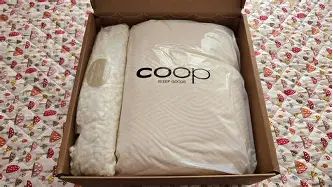
Coop Adjustable Latex Pillow (what it is and who it targets)
The Coop Adjustable Latex Pillow is designed around customization. Its central promise is that users can tune loft and firmness by adding or removing fill—often combining latex layers or a latex core with adjustable inserts—so the pillow can be tailored to different body types and sleep styles. It typically appeals to buyers who want a natural, responsive material (latex) and who value the ability to change the pillow over time as their preferences evolve or as sleep-related conditions (like a new neck injury) change.
Detailed product analysis
Comfort and support by sleep position
Side sleepers: Side sleepers need adequate loft and lateral support to keep the neck aligned with the spine. The Purple Harmony's responsive grid top and medium-firm support tend to offer stable shoulder cushioning with less compressive sink than traditional memory foam. The grid's lateral resilience helps preserve loft under the heavier load of a side sleeper's head and shoulder.
The Coop Adjustable Latex Pillow excels here if adjusted correctly: once filled to a suitable loft, latex provides buoyant support that resists compression and can keep the cervical spine aligned. The advantage is that users can tune loft to their shoulder width—particularly useful for very petite or broad-shouldered side sleepers.
Back sleepers: Both pillows are suitable for back sleepers who need moderate loft. The Purple Harmony usually creates a cradle-like feeling with responsive support that prevents the head from tilting forward. The Coop Adjustable Latex Pillow can be dialed to a lower loft to prevent chin-tuck, and latex's bounce helps return the head to neutral positions during sleep.
Stomach sleepers: Stomach sleepers typically require low loft to avoid neck extension. The Coop's adjustability gives it an edge: fill can be removed to achieve a flatter profile. The Purple Harmony, while not excessively high in many configurations, may still feel too supportive for committed stomach sleepers because of its resilience and resulting elevation.
Discover deals on Electronics — updated daily.
Browse Now →Temperature regulation and breathability
Cooling is often a deciding factor. The Purple Harmony leverages the open-grid polymer layer, which allows air movement and tends to feel cooler to initial touch. Users who live in warm climates or who tend to overheat during the night often report fewer wake-ups due to heat with the grid-style construction.
Coop's latex-based pillow benefits from latex's natural breathability and sometimes includes perforations or ventilated cores. However, latex can trap less heat than dense memory foam but more than an open-polymer grid in direct-contact scenarios. The Coop's advantage is the ability to spread the fill differently or use a lower loft to increase airflow around the neck and face.
Adjustability and customization
This is a clear area of divergence. The Purple Harmony offers limited to no user-level fill adjustment—its structure is engineered for an intended consistent feel. That can be an advantage for buyers who prefer set-and-forget comfort, but it can be a drawback for people who need to refine loft and firmness over time.
The Coop Adjustable Latex Pillow's entire selling point is customization: a removable fill system or adjustable internal layers allow users to tune the pillow's height and firmness. This makes it particularly attractive to households with multiple sleepers who share a pillow or to people whose needs change because of injury, pregnancy, or changing mattress firmness.
Durability and maintenance
Durability tends to favor materials that resist compression and do not break down quickly. Purple's polymer grid is notably resilient and often retains its structure longer than conventional foams. The Harmony's performance over time is typically stable, with less sagging and fewer complaints about flattening after months of use.
Latex is also a durable material, with natural latex historically outlasting many memory foams in terms of loft retention. The adjustable nature of the Coop pillow can help prolong usable life because users can top up or reconfigure fill rather than replacing the entire pillow. Maintenance-wise, adjustable pillows often have removable covers and are easier to wash at the surface level—but full-core washing may not be possible for latex inserts, so follow care instructions.
Allergen considerations and off-gassing
Natural latex can be an allergen for a segment of the population. Buyers with latex sensitivity should verify material sources and certifications. The Purple Harmony's polymer grid is inert and generally hypoallergenic, though any pillow with foam layers might emit a mild initial odor depending on packaging and transport; this typically dissipates within days.
Noise and motion transfer
Neither pillow is expected to create significant mechanical noise in normal use, but latex can sometimes have a subtle squeak in rare cases if the cover and insert rub in certain positions. Motion transfer is minimal for both—Purple's grid localizes pressure well, and latex does not have the slow-motion transfer typical of dense memory foam.
Pros & Cons
Purple Harmony
- Pros: Excellent pressure relief with a unique responsive feel; very good airflow and cooling; durable grid material that resists sagging; immediate responsiveness—no break-in period required.
- Cons: Limited adjustability—one fixed profile may not suit all body types; the feel is different from traditional foam and may take getting used to; higher price point for proprietary materials.
Coop Adjustable Latex Pillow
- Pros: Highly adjustable loft and firmness; natural, buoyant latex feel favored by many for neck support; adaptable across sleep positions; often easier to customize for couples and evolving needs.
- Cons: Potential latex allergy for some users; ventilation and cooling vary by configuration; quality and responsiveness depend on how the pillow is filled and adjusted.
Side-by-side comparison
| Feature | Purple Harmony | Coop Adjustable Latex Pillow |
|---|---|---|
| Primary material | Hyper-elastic polymer grid + foam layers | Natural latex core or latex + adjustable fill |
| Adjustability | Low — designed for consistent manufacturer-set profile | High — removable/adjustable fill to change loft and firmness |
| Best for | Hot sleepers, pressure-relief seekers, those who want immediate responsiveness | Buyers who need custom loft, people who prefer natural materials, a range of sleep positions |
| Cooling | Very good — grid enables airflow | Good — latex breathes but depends on configuration |
| Durability | High — grid resists long-term compression | High — natural latex durable; adjustable fill can prolong use |
| Allergy risk | Low — inert polymer; check covers for treatments | Medium — latex allergy potential; check certifications |
| Ease of maintenance | Cover usually removable and machine-washable; core not machine-washable | Cover often removable; fill may be unwashable—spot clean latex |
Real-world use cases
Understanding typical scenarios helps translate product features into direct benefits.
Looking for the best Electronics deals on Amazon?
Browse Now →Hot sleepers
The Purple Harmony generally performs better for people who overheat at night because the open polymer grid creates channels for airflow. It is well-suited for warm bedrooms or users who sleep close to high-thermal mattress materials.
People with neck or shoulder pain
Both pillows can be beneficial. Purple's grid provides targeted pressure relief and supportive contouring; Coop's latex supports the cervical spine with a buoyant feel that prevents the head from sinking and flipping forward. The key for pain sufferers is correct loft selection—Coop's adjustability gives an advantage here if the pillow is tuned properly.

Couples and shared beds
Couples often have different loft preferences. Coop's adjustable approach allows each partner to tune the shared pillow or use separate pillows with different fills. Purple's single-profile design may be ideal if both partners prefer a similar responsive, cooling feel.
Allergy-sensitive users
Users with latex sensitivities should avoid latex-based models. Purple's materials are generally hypoallergenic; however, buyers should confirm cover treatments and certifications to ensure dust-mite protection or antimicrobial finishes if those are priorities.
Buying guide — what to evaluate before choosing
Buyers should match pillow features to sleep needs rather than brand alone. The following checklist helps during research and tryouts.
- Sleep position and body type: Side sleepers need higher loft and firmer lateral support; stomach sleepers need lower loft; back sleepers require medium loft. Measure shoulder width for side-sleeping adjustments.
- Adjustability needs: If unsure about preferred loft or if different household members share a pillow, prioritize adjustability.
- Temperature considerations: If night sweats or warm bedrooms are common, look for open-cell or grid-like constructions that encourage airflow.
- Allergies and materials: Verify latex content, natural vs. synthetic labels, and look for hypoallergenic covers and certifications (OEKO-TEX, GOLS, etc.) if sensitivity is a concern.
- Care and maintenance: Check whether covers are machine-washable, whether the core requires spot-cleaning, and how easy it is to re-fluff or adjust the fill.
- Trial period and warranty: Sleep trials and warranty length matter. A generous trial period reduces risk; long warranties often indicate manufacturer confidence in durability.
- Noise and motion: For those sensitive to motion transfer (co-sleepers), prioritize materials that localize movement; for those light sleepers, ensure the pillow remains quiet during position changes.
- Value and longevity: Consider not just upfront cost but the expected lifetime of usable loft and support. Durable materials like polymer grids and natural latex often justify a higher initial price.
Practical tips for testing a pillow at home
- Spend at least a week sleeping on a new pillow to allow for subjective adaptation.
- Simulate usual sleep conditions during the test—same mattress, bedding, and room temperature.
- For adjustable pillows, experiment with small increments of fill removal/addition and track differences in neck alignment and morning pain.
- Place the pillow in an open room for 24–48 hours before first use to reduce any packaging odor and to let materials settle.
Conclusion
Which pillow is actually better depends on the buyer's priorities. The Purple Harmony shines for those who want immediate, consistent pressure relief combined with superior airflow and a novel responsive feel—an excellent option for hot sleepers and anyone seeking a low-maintenance, high-performance design. The Coop Adjustable Latex Pillow is the better choice for people who value customization, natural materials, and the ability to fine-tune loft and firmness over time—especially useful for side sleepers, couples with differing preferences, and anyone whose needs may change.
In short, choose Purple Harmony for cooling and a distinctive responsive support out of the box; choose Coop Adjustable Latex Pillow for personalization and a buoyant, natural latex sensation. Buyers who remain undecided could benefit most from testing an adjustable latex option first—because loft and firmness are the most common reasons pillows fail to match expectations, and adjustability reduces that risk. Ultimately, matching pillow properties to sleep style and specific pain or temperature concerns is the most reliable path to better sleep.