Is the Chuwi Corebook Air Business Laptop Still Good in 2026? Long-Term Review
Introduction
I've been using the Chuwi Corebook Air as my daily carry laptop for about nine months now. I picked it up because I wanted an ultraportable machine with a clean design, a good display for text and light photo editing, and — importantly — a price that didn't force me to compromise on build quality. Over those months I've worked on articles, handled spreadsheets, edited photos, joined long video calls, and taken it on a few short trips. What I found was a surprisingly capable little machine that has obvious trade-offs. This long-term review is the experience I wish I had read before buying: candid, practical, and focused on what actually matters after real use.
What I bought (my configuration)
The specific unit I bought is the mid-level Corebook Air configuration available at the time: a 13.3" high-resolution IPS display, 8 GB of RAM, a 256 GB NVMe SSD, and a low-power Intel U-series processor (the label on my unit indicated an i5-class U-series chip). It shipped with Windows and the usual preinstalled utilities. I also got the optional sleeve and a compact USB-C charger that came in the box.
First impressions and build quality
Right out of the box I appreciated the industrial design. The Corebook Air feels denser than its price would suggest — the aluminum lid and deck give it a premium look and the hinge is stiff enough to be reassuring but does let you open the laptop with one hand if you use the corner. The machine is light enough for daily carry (I measured a subjective weight that feels like a small 13-inch ultrabook), and the footprint fits nicely into most messenger bags and medium backpacks.
One thing I noticed early on that bothered me a bit: the bottom panel has small gaps around the ports where the trim doesn't quite sit flush. It's not a structural problem, but it made me aware of the build's manufacturing tolerances. After nine months the finish has held up well — only minor surface marks on the palm rest where my wrists rest — which is impressive for an inexpensive aluminum chassis.
Display and multimedia
The 13.3-inch panel is one of the Corebook Air's stronger suits. Text is sharp for 13.3", and the color tuning is warm and pleasant for productivity work and photo editing at a hobbyist level. I noticed slightly limited peak brightness: outdoors on a bright day the screen is usable but not brilliant, and I often had to seek shade. Viewing angles are excellent thanks to the IPS panel.
Speakers are average — louder than a Chromebook or a thin tablet, but lacking bass and body for any real media immersion. For video calls they are fine, but I always prefer a headset on crowded flights. The webcam is adequate for Zoom and Teams, with grain and limited dynamic range in dim light; I upgraded to a small external webcam for better conference-room quality.
Keyboard, trackpad, and daily usability
The keyboard surprised me in a good way. Key travel is moderate, and the layout is comfortable for long typing sessions. After a few days I settled into the spacing and rarely mis-typed. The backlight is bright enough for late-night work, though the two-stage brightness control is coarse.
The trackpad is large and made Windows Precision drivers available on my unit, which meant smooth gestures and reliable cursor control. It isn't a glass trackpad like higher-end machines, but I've had no issues dragging files or performing multi-finger gestures. The fingerprint sensor built into the power button has been convenient and consistent.
Performance and thermal behavior
In my experience the Corebook Air handles day-to-day tasks — web browsing with multiple tabs, email, document editing, Slack, light IDE work, and 1080p video playback — easily. The 8 GB RAM is a limit if you like dozens of Chrome tabs plus background VMs or large photo files; I found occasional memory pressure in heavy multitasking, leading to brief pauses until Windows trimmed memory.
Looking for the best Laptops & Computers deals on Amazon?
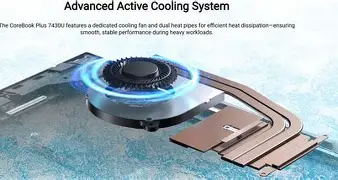
Shop Amazon →During sustained CPU-heavy workloads (I ran a few code compile sessions and exported some 4K clips at a hobbyist level), the laptop got warm on the underside and showed mild thermal throttling: peak CPU performance dropped after sustained load, and fans (or internal vents, in this model mostly passive/a little forced) became audible. It's not a machine for long video renders or heavy 3D work — for those tasks a bigger machine is better — but for everything else the performance is perfectly adequate. Battery life during normal mixed-use days averaged between 6 and 8 hours: writing, browsing, and streaming at medium brightness. With light use and aggressive power settings I saw closer to 9 hours. Charging from the compact USB-C charger was convenient; full charge took roughly 1.5 to 2 hours from near empty.
Ports and expandability
The Corebook Air gives a sensible set of ports for an ultraportable: at least one USB-C with charging support, a USB-A, a headphone jack, and a microSD slot in my unit. I used the microSD mostly for quick photo transfers and the USB-C port to power the machine and connect a dongle to an external monitor. I appreciated not having to carry a hub for the occasional wired mouse or thumb drive, but heavy peripheral users will still want a small USB-C dock.
Storage is soldered in many budget ultraportables, and while my SSD is NVMe and fast enough for daily use, the lack of a user-accessible bay means upgrading storage requires careful planning. If you need more space for large media projects, plan to use external SSDs or choose a config with more internal storage from the start.
Software, drivers, and reliability
Here is where living with the Corebook Air became more "real" after several months. Out of the box Windows ran smoothly, but after a couple of major Windows updates I ran into driver mismatches that caused temporary issues with the trackpad gestures and sleep/resume behavior. I fixed both by downloading the latest drivers from Chuwi's support page and installing them manually. That process worked, but it does require a little patience and technical comfort.
I've had one BIOS/firmware update in nine months; the process was straightforward but the release notes were sparse. Customer support was helpful but not lightning-fast — expect a couple of business days for an email response and occasional follow-ups to get the right driver package. If you value ironclad post-sale support, larger OEMs still have an edge.
Durability and long-term ownership
After nine months of daily commuting and travel the Corebook Air has held up well. The hinge has not loosened, and wear is limited to minor scuffs on the lower chassis. Battery health appears within normal expectations: I still get a useful 6+ hour day, and battery wear is not drastic. If you plan to keep the machine for several years, know that battery degradation is inevitable; you should be comfortable with somewhat degraded runtimes after two or three years, especially with heavier use.
Who is this laptop for?
In my experience the Corebook Air makes sense for students, writers, travelers who prioritize light weight, and professionals who do mostly web-based work or office apps. It’s an excellent fallback travel machine when you need a reasonable screen and a keyboard that supports comfortable typing for hours. It's less suitable for creators doing sustained video rendering, heavy software development with large local builds, or gamers.
Comparison: Corebook Air vs typical alternatives
| Chuwi Corebook Air (my unit) | Premium ultraportable (e.g., flagship 13") | Budget ultraportable (other value brands) | |
|---|---|---|---|
| Build & finish | Aluminum, solid for price, minor trim gaps | Top-tier machining, uniform fit & finish | Plastic or mixed materials, varies |
| Display | Sharp IPS 13.3", great for text & photos, limited peak brightness | Excellent color & brightness, sometimes OLED options | Decent, sometimes lower resolution or TN panels |
| Performance | Good for productivity; thermal throttling under sustained heavy load | Stronger sustained performance and better cooling | Basic productivity OK, variable performance |
| Battery | 6–9 hours real-world depending on use | Often 8–12+ hours with optimized hardware | 4–8 hours; depends on battery size |
| Support & updates | Decent but slower; manual driver installs sometimes required | Strong OEM support and frequent firmware updates | Support varies; sometimes community-driven |
| Value | Excellent price-to-spec ratio | Premium price for premium experience | Low cost but varying quality |
Pros & Cons
- Pros:
- Excellent value for the build quality and display.
- Light and highly portable — comfortable to carry daily.
- Keyboard and trackpad are strong for the price category.
- Good battery life in everyday mixed-use scenarios.
- Clean, professional design that doesn't shout "budget."
- Cons:
- Drivers and firmware sometimes require manual updates after major Windows patches.
- Thermal throttling under long sustained workloads; not for heavy rendering or gaming.
- Limited upgrade options (storage/RAM often fixed).
- Speakers and webcam are only average.
- Customer support is responsive but not as fast or thorough as larger OEMs.
Buying guide: what to check before you buy
1. Pick the right configuration for your needs
If you plan to keep this laptop for a few years, spend a little more on the configuration with the larger SSD or more RAM (if available). 8 GB is okay for most web-heavy workflows, but 16 GB will extend the machine's usefulness for multitasking and light editing.
Find top-rated Laptops & Computers products at great prices.
Browse Now →2. Check the ports and charging method
Decide whether you need HDMI or a full-size USB-A port; if your unit lacks something you rely on, budget for a compact dongle or a small USB-C dock. Confirm the USB-C charging capabilities so your current charger or power bank will work.
3. Ask about warranty and support
Chuwi offers warranties in most regions but policies vary. Check the warranty length and what it covers, and be prepared for slightly slower official support responses than premium brands. Factor the warranty into the total ownership cost if you care about quick repairs.
4. Prepare for driver updates
After major Windows feature updates I recommend checking Chuwi's support site for updated drivers and installing them manually if you notice regressions in touchpad, sleep, or audio behavior. Keep a small USB drive with the latest drivers backed up so you can recover quickly if Windows update causes an issue.
5. Accessories to consider
A thin sleeve or folio, a compact USB-C charger (if not included), and a small USB-C dock for occasional external monitors or Ethernet are the most practical accessories. If you do frequent video calls, an external webcam or a better headset will make a noticeable difference.
Final thoughts and conclusion
After using the Corebook Air for nine months I'm still impressed by the overall package. It nails what it sets out to do: deliver a lightweight, well-built, and affordable ultraportable with a nice display and a comfortable keyboard. Its value proposition is clear — you get a machine that looks and feels more expensive than it is.
That said, the Corebook Air is not without compromises. If your workflow depends on maximum sustained CPU performance, heavy local builds, or excellent OEM support, you'll want to consider a higher-tier laptop. Likewise, if you expect the laptop to be trivially serviceable or to accept future upgrades, look elsewhere or choose a configuration that future-proofs as much as possible.
In my experience, if you want a dependable daily driver for writing, web apps, light editing, and travel that doesn't force you to mortgage your budget, the Corebook Air remains a very sensible choice in 2026. It has held up well under regular use, and the things that bothered me (driver updates and limited upgradeability) are manageable once you know what to expect. I still reach for it when I want something light and unobtrusive that gets work done without fuss — and for that reason it's earned a permanent place in my bag.